What Lead Data Enrichment Actually Fixes in B2B Outreach Workflows
Learn what lead data enrichment adds to B2B lead lists, which fields matter most, and how enriched records improve outreach, routing, segmentation, and CRM workflows.
A lot of teams think the hard part is getting the lead list.
In practice, the harder part often comes next.
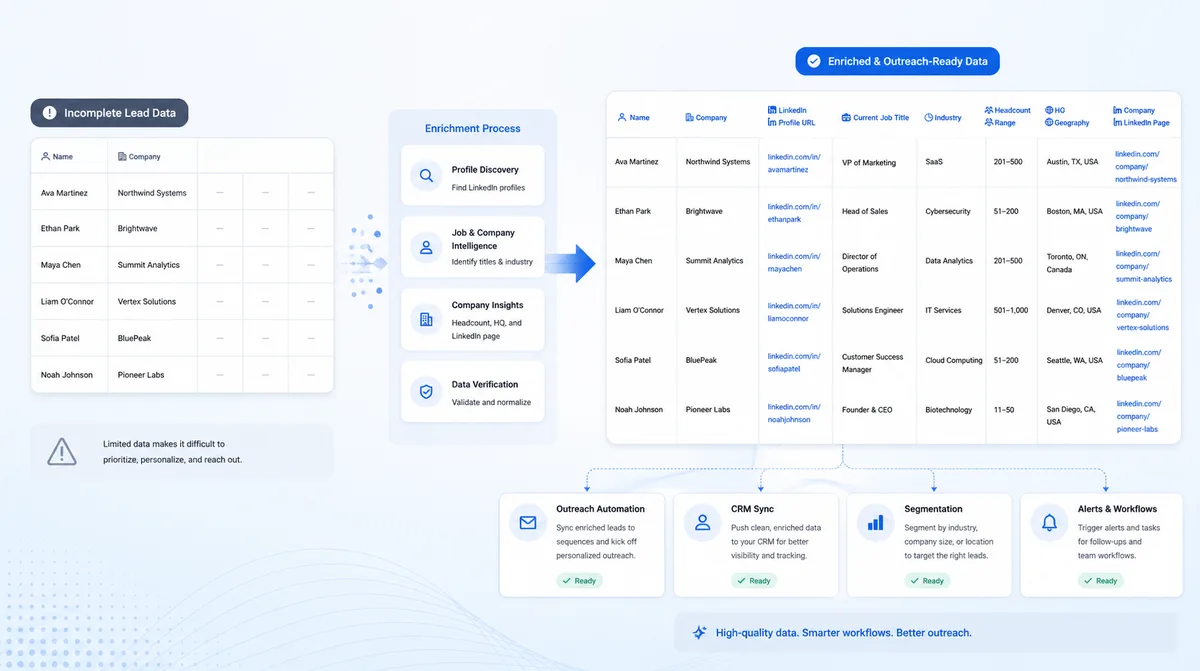
You may already have names, companies, and maybe email addresses. But when the list is missing LinkedIn profile URLs, current job titles, company size, industry, or geography, the records are harder to segment, route, review, and use for outreach. That is the gap lead data enrichment is meant to fix.
For marketing ops, SDR managers, CRM admins, and data teams, enrichment is less about adding more data for its own sake. It is about making an existing list more usable. When the right fields are present, outreach workflows become easier to run, CRM records become more complete, and downstream handoffs create less manual cleanup. NameToProfile’s lead data enrichment service is built around that exact use case: taking an existing lead file and appending missing LinkedIn and firmographic data so the list is more useful in real operating workflows.
Why incomplete lead lists create downstream problems
A list with basic identity fields is often not enough to support the next step in the workflow.
If a record only includes a person’s name, company, and maybe an email address, the team still has gaps. It may be unclear what the person’s current role is, whether the account fits the target segment, which geography they belong to, or how to review the record quickly inside a spreadsheet or CRM. Many lead lists arrive without LinkedIn profile URLs, company size, industry, or job title data, which makes segmentation and outreach harder than they should be.
That missing context creates friction in a few predictable ways:
- SDR teams cannot prioritize or personalize as efficiently.
- Marketing ops teams have less to work with for routing and segmentation.
- CRM admins inherit incomplete records that require more cleanup.
- Data teams spend more time standardizing inputs before the records are useful.
The problem is not that the leads are unusable. It is that they are not yet workflow-ready.
What lead data enrichment means in practice
Lead data enrichment means appending missing fields to the records you already have.
That can include LinkedIn public profile URLs, current job title verification or correction, company name standardization, company firmographics such as industry, headcount range, and HQ geography, plus company LinkedIn page URLs. Where available from public sources, it can also include direct business contact channels such as work email and business phone number, along with fallback company generic email and switchboard phone. Optional seniority inference from job title can also be useful.
That is a useful way to explain enrichment. It is not just more fields. It is missing business context that makes the list easier to use.
In practical terms, lead data enrichment is the process of taking an existing lead file and appending the missing identity, role, company, and firmographic fields needed to make the records more useful for outreach, CRM preparation, routing, and segmentation.
Which lead sources usually need enrichment most
Not every list starts clean.
Some of the most common lead sources that need enrichment include:
- Contact lists with name and company but no LinkedIn URL
- Event registration or webinar attendee exports
- Inbound form-fill records that need firmographic context
- Purchased lists missing qualification fields
These inputs are common because they usually contain enough information to identify the person, but not enough to support strong downstream execution.
For example, an event export may tell you who attended, but not whether the contact matches your ICP. A purchased list may include an email but not a trustworthy current title or company context. An inbound form fill may create a record in the CRM, but without the fields needed for proper routing or prioritization.
Enrichment helps bridge that gap.
The fields that make a lead list more usable
Not every field matters equally. The most valuable fields are the ones that make the next action easier.
LinkedIn public profile URL
This is especially useful for research, review, and spreadsheet workflows. A clean public profile URL is often easier to inspect, store, and share internally than a less usable source link format.
Current job title
Job title affects targeting, prioritization, and message relevance. Verified or corrected title data matters because stale or inconsistent titles can weaken segmentation and personalization.
Company standardization and firmographics
Standardized company names, industry, headcount range, and HQ geography make a lead list more useful for filtering, scoring, territory logic, and account-level research.
Company LinkedIn page URL
This helps connect person-level records to account research and can make lists easier to review when teams are checking both contact and company context.
Business contact channels where available
Direct business email and direct business phone can make the file more usable for outreach or follow-up workflows, though coverage will vary by input quality and matchability.
How enriched lead data improves actual team workflows
The best way to explain enrichment is to connect it to real teams.
SDR teams
For SDR managers preparing cold outreach lists, better fields improve list readiness. Reps can sort by role, segment by company size or geography, and review the right LinkedIn profile reference more quickly.
Marketing ops teams
Marketing ops teams often need more complete records before routing MQLs or applying segmentation logic. Incomplete data makes routing logic weaker. Enriched data makes it more usable.
CRM admins
CRM admins care about field completeness and cleaner account-contact records. Enrichment supports that by improving the input record before more cleanup work piles up.
Data teams
Data teams building enrichment pipelines need predictable outputs and clearer coverage. Service-based enrichment can fit operational processes rather than just one-off list cleanup.
A simple lead enrichment workflow
One reason service-based enrichment is appealing is that the workflow is straightforward.
- Share your lead file.
- Match records using name, company, and other available signals.
- Append the requested enrichment fields while flagging unmatched records.
- Deliver the enriched file back in CSV or Excel format with a match-rate summary.
That structure is useful because it keeps the value grounded in operations.
You are not rethinking your entire sales stack. You are improving the quality of an existing working file.
That matters because many teams already have a spreadsheet, export, or CRM-derived list. What they lack is a clean way to turn those partial records into something more usable.
What to look for in a lead data enrichment service
If you are evaluating options, there are a few practical criteria worth focusing on.
First, field coverage should be clear. You should know exactly what can be appended, such as LinkedIn profile URLs, verified titles, firmographics, company URLs, and public business contact fields where available.
Second, the workflow should fit how teams already operate. CSV and Excel delivery matter because many ops, SDR, and CRM workflows still begin or end in spreadsheets.
Third, match transparency matters. Unmatched records should be flagged, and delivery should include a match-rate summary. That gives teams visibility into coverage instead of pretending every record will be resolved equally well.
Finally, pricing should match the real scope of the job. Good enrichment work varies based on record count, requested fields, and expected match rate.
Where NameToProfile fits
NameToProfile fits best when a team already has the leads but the records are not complete enough for smooth downstream use.
That could mean:
- No LinkedIn profile URLs
- Missing or stale job title data
- No company size or industry
- No company LinkedIn page URL
- Missing business contact channels where public-source coverage is available
You already have a lead list, but it is missing fields that matter. NameToProfile helps append missing LinkedIn and firmographic data so outreach and segmentation work more effectively.
That is a strong positioning point because it keeps the service grounded in workflow improvement. It is not a vague promise about better data. It is a practical service for making lead lists more usable.
Final takeaway
Lead data enrichment is valuable when it solves an operational problem.
The goal is not to make a spreadsheet look fuller. The goal is to give sales, ops, and CRM teams the fields they need to segment, route, review, and act on lead records with less friction.
When a list includes usable LinkedIn profile URLs, verified titles, cleaner company references, and firmographic context, the downstream work gets easier. That is the real benefit.
For teams already working with partial exports, event lists, inbound records, or purchased data, enrichment can be the difference between “we have leads” and “we have a list we can actually use.”
Need help enriching an existing lead list?
If your file is missing LinkedIn profile URLs, job title data, or firmographic context, NameToProfile can help make those records more useful for outreach, routing, and CRM workflows.