Most prospecting problems aren't outreach problems. They're targeting problems.
If your team spends hours finding leads, only to discover they aren't a fit, the issue usually starts before the first search, score, or message. Without a clear definition of who you're trying to reach, every salesperson, SDR, and marketing team member ends up working from a different version of your ideal customer.
That's where an ICP brief comes in.
An ICP brief turns your ideal customer profile into an operational system. Instead of sitting in a slide deck that nobody updates, it becomes the shared foundation for prospecting, qualification, lead scoring, and outreach.
In this guide, you'll learn what an ICP brief is, what should be included in one, and how to use it to improve prospecting performance across your entire sales workflow.
What Is an ICP Brief?
An ICP brief is a structured document that defines your ideal customer in enough detail for prospecting, qualification, scoring, and messaging decisions.
Unlike a traditional ICP document that often lives in marketing presentations, an ICP brief is designed to be operational. It tells your team exactly who qualifies, who doesn't, what buying signals matter, and how to prioritize opportunities.
ICP vs Buyer Persona
An ideal customer profile focuses on companies and accounts. A buyer persona focuses on the people inside those companies.
| ICP | Buyer Persona |
|---|---|
| Defines target companies | Defines individual buyers |
| Company size, industry, geography | Goals, motivations, challenges |
| Used for qualification | Used for messaging |
| Determines account fit | Determines communication strategy |
Strong prospecting requires both. The ICP identifies which accounts deserve attention. Personas help determine how to communicate with decision-makers inside those accounts.
What Belongs in an Effective ICP Brief?
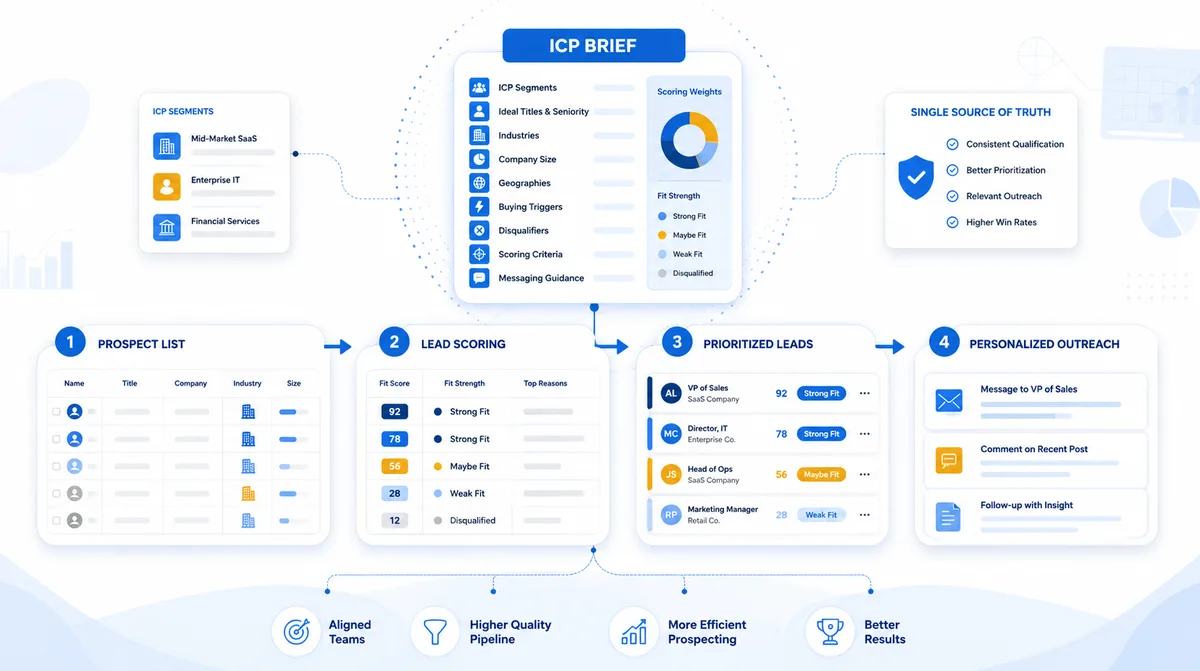
A useful ICP brief typically includes:
- Target industries
- Company size ranges
- Geographic markets
- Decision-maker titles
- Seniority levels
- Buying triggers
- Disqualifiers
- Scoring criteria
- Messaging recommendations
The goal is clarity. Anyone reviewing a prospect should be able to quickly determine whether that account belongs in the pipeline.
Why a Single ICP Brief Creates Better Prospecting
Many organizations have multiple definitions of a qualified lead. Marketing uses one set of criteria. Sales uses another. Agencies and contractors often create their own interpretations.
This inconsistency creates wasted effort and lower conversion rates.
Consistent Qualification
When everyone works from the same ICP brief, qualification becomes predictable. Teams evaluate opportunities using the same standards rather than personal judgment.
Better Lead Prioritization
Not all prospects deserve equal attention.
A well-defined ICP brief helps teams quickly identify strong-fit opportunities and focus resources where they're most likely to generate results.
More Relevant Outreach
Buying triggers, common challenges, and messaging guidance provide context for outreach. Instead of generic templates, sales teams can tailor communication around issues that matter to the prospect.
| Without an ICP Brief | With an ICP Brief |
|---|---|
| Inconsistent targeting | Standardized qualification |
| Manual lead reviews | Structured prioritization |
| Generic outreach | Context-driven messaging |
| Higher lead waste | Improved fit and focus |
The Components of a High-Performing ICP Brief
The best ICP briefs balance precision with practicality.
ICP Segments
Most companies serve more than one type of customer.
For example, a cybersecurity vendor might have separate segments for mid-market SaaS companies, enterprise healthcare organizations, and managed service providers.
Each segment should include clear criteria for qualification.
Buying Triggers
Buying triggers indicate that a prospect may be actively considering a solution.
Examples include:
- Recent funding rounds
- Rapid hiring growth
- Technology migrations
- Leadership changes
- Expansion into new markets
These signals often help prioritize outreach timing.
Disqualifiers
Many teams focus only on who they want.
High-performing teams also define who they don't want.
Examples include:
- Companies below a minimum employee count
- Industries with poor retention history
- Regions without sales coverage
- Organizations lacking budget authority
Disqualifiers reduce wasted prospecting effort.
Scoring Criteria
A scoring framework translates ICP fit into measurable signals.
Common scoring factors include:
- Title relevance
- Seniority level
- Industry fit
- Company size match
- Buying trigger presence
- Disqualifier penalties
This allows teams to prioritize opportunities objectively.
Voice and Positioning Guidance
Beyond qualification, a strong ICP brief helps shape communication.
Different audiences respond to different messages. Technical buyers, founders, and operations leaders often care about different outcomes.
Documenting these differences improves consistency across outreach efforts.
How NameToProfile Uses an ICP Brief Across the Workflow
NameToProfile is built around the idea that one ICP brief should power every stage of prospecting. Rather than recreating targeting criteria across multiple tools, users define their ideal customer once and apply that definition throughout the workflow.
Generate the Brief
The platform can generate a structured ICP brief using information from your company website and LinkedIn profile. The resulting brief includes ICP segments, buying triggers, disqualifiers, engagement recommendations, and scoring criteria. Up to three active briefs can be maintained per account.
Score Leads Against the Brief
Once approved, the brief becomes the foundation for lead scoring.
Fast scoring helps teams triage large prospect lists, while Deep scoring adds AI-powered analysis and recommendations for shortlisted opportunities. Both methods evaluate prospects against the same ICP definition.
Guide Prospecting and Extraction
When building prospect lists, teams can use ICP criteria to determine which leads should be retained, prioritized, or discarded before outreach begins. This helps maintain list quality as volume grows.
Improve Outreach Quality
Because the brief contains buying triggers and positioning guidance, messaging can align with prospect priorities rather than relying on generic templates. The result is outreach that feels more relevant and contextual.
Step-by-Step: Creating Your First ICP Brief
1. Analyze Existing Customers
Start with your best customers rather than assumptions.
Look for common characteristics among accounts with high retention, strong expansion potential, and positive outcomes.
2. Identify Shared Traits
Document patterns such as industry, company size, geography, technology stack, and decision-maker roles.
3. Define Triggers and Disqualifiers
Determine which events indicate buying readiness and which characteristics suggest poor fit.
4. Create Scoring Rules
Assign relative importance to qualification factors so leads can be prioritized consistently.
5. Test and Refine
An ICP brief should evolve over time.
Review conversion data regularly and update criteria as you learn more about successful customers.
Common ICP Brief Mistakes
Targeting Everyone
If everyone qualifies, nobody qualifies. Broad targeting usually reduces efficiency and conversion rates.
Ignoring Disqualifiers
Without exclusion criteria, prospecting teams spend time evaluating opportunities that were never likely to convert.
Confusing Personas with ICPs
Personas describe people. ICPs describe organizations. Mixing the two often creates confusion during qualification.
Never Updating the Brief
Markets change. Products evolve. Customer needs shift.
Your ICP brief should be reviewed regularly to ensure it still reflects reality.
When Should You Create Multiple ICP Briefs?
A single ICP brief is often sufficient for smaller organizations. However, multiple briefs may make sense when customer segments differ significantly.
Different Products
Products serving different buyers often require separate qualification criteria.
Different Markets
Enterprise and SMB buyers frequently have different priorities, budgets, and buying processes.
Agencies Managing Multiple Clients
Agencies typically need distinct ICP definitions for each client engagement.
This ensures prospecting remains aligned with each client's objectives.
Conclusion
An ICP brief is more than a planning document. It's the operational foundation that connects prospecting, lead qualification, scoring, and outreach.
When teams share a single definition of the ideal customer, they spend less time debating lead quality and more time engaging prospects who are genuinely likely to buy.
If you want a single source of truth for prospecting, scoring, and outreach, start by creating a structured ICP Brief, then connect it with Lead Scoring, the Sales Nav Extractor, and Engage to build a more focused prospecting workflow.