Most teams don't have a lead problem — they have a prioritization problem. The list is long, the reps are few, and without a consistent way to say "this one first, that one later," the newest name or the loudest opinion wins. Fit scoring fixes that. It turns your definition of a good customer into a number on every record, so the queue sorts itself and everyone works the same way.
The catch is that scoring done badly is just as misleading as no scoring at all. A single opaque number nobody trusts gets ignored within a week. What holds up is a simple, transparent framework: score fast to triage the whole list, score deep only where it matters, and route on clear thresholds. Here's how to build that, step by step, using one definition of your ideal customer across whatever sources you already work in — Apollo, ZoomInfo, Clay, your CRM, CSV/Excel exports, and public web sources.
What "fit" means before you score anything
Fit scoring answers one question: how closely does this record match the customer you actually want? That's different from intent (are they in-market now?) and from engagement (have they opened your emails?). Fit is the stable layer — it changes slowly and applies to every lead, which is why it's the right thing to score first.
The whole framework depends on having a written definition to score against. If your criteria live in three people's heads, every rep scores differently. Capturing that definition once — the firmographics, the roles, the disqualifiers — is what an ICP brief is for: a single source of truth that both a fast rule engine and a language model can read the same way.
| Layer | Question it answers | Changes |
|---|---|---|
| Fit | Do they match our ideal customer? | Slowly |
| Intent | Are they in-market right now? | Weekly |
| Engagement | Are they responding to us? | Daily |
Score fit first because it's cheap, stable, and it decides who's even worth watching for intent and engagement.
Step 1 — Turn your ICP into scored criteria
Start from the brief and make each criterion explicit and weighted. Decide which attributes are must-haves (a miss disqualifies the record) and which are nice-to-haves (a miss just lowers the score). A B2B example:
| Criterion | Type | Weight |
|---|---|---|
| Industry in target verticals | Must-have | High |
| Employee count 50–500 | Must-have | High |
| Buyer title (VP/Director in function) | Must-have | High |
| Uses a relevant tech in their stack | Nice-to-have | Medium |
| HQ in serviceable geography | Nice-to-have | Low |
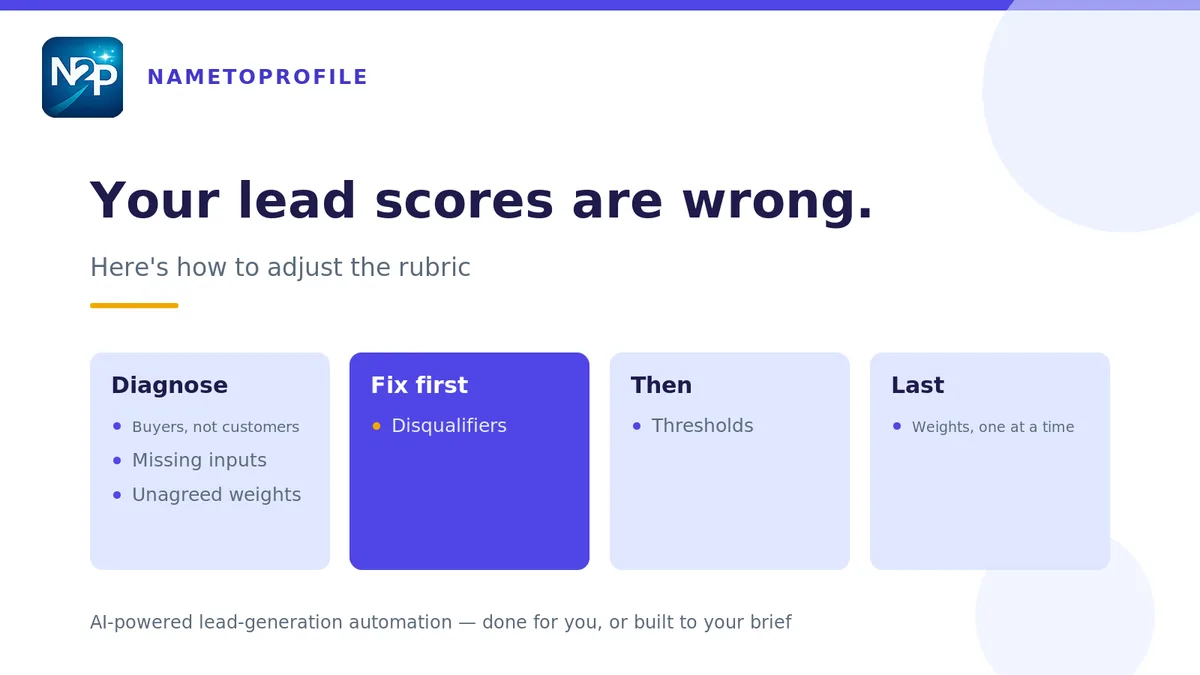
Write the disqualifiers down too — wrong industry, too small, competitor, student or personal account. A disqualifier should force a low score no matter how many nice-to-haves are present.
Step 2 — Run a Fast pass across the whole list
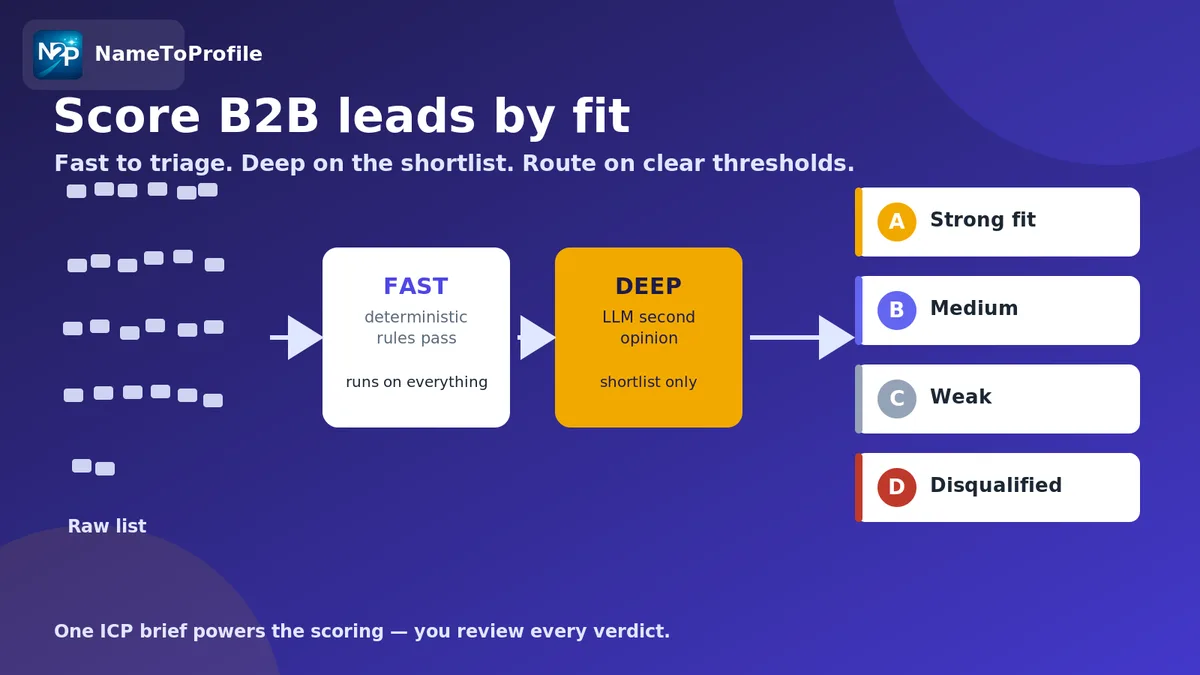
The first pass should be deterministic: rules applied to the structured fields you already have, no language model needed. It's cheap enough to run on every record, it's consistent, and it's explainable — you can always point at exactly which rule fired. Use it to triage the full list into rough bands (strong / medium / weak) so nobody spends deep-analysis time on records a rule could reject.
This is the "Fast" half of a two-speed approach. A deterministic fit-scoring pass is designed for exactly this: it's the wide, inexpensive filter that shrinks the list before any expensive reasoning happens. In practice you run Fast on everything and only promote the records that clear your must-haves.
Step 3 — Run a Deep pass on the shortlist only
Deterministic rules miss nuance — a company that's technically out of your size band but clearly a fit for other reasons, or a title that doesn't match your list but describes the right buyer. That's where a second, LLM-based opinion earns its cost. It reads the record in context, weighs the softer signals, and gives you a reasoned verdict with the "why."
Because a Deep pass costs more, you only run it on records that survived the Fast pass — the shortlist, not the universe. This is the same "triage wide, analyze narrow" pattern behind qualifying prospects in the moment; if you want the hands-on version, see how to qualify prospects in seconds with an AI sales assistant. The AI Sales Assistant scores a profile or company against your brief and drafts the next step in your voice — and, importantly, nothing is sent or posted on your behalf. You review every verdict before it counts.
Step 4 — Set thresholds and route
A score is only useful if it changes what happens next. Translate the combined Fast + Deep result into bands and attach an action to each:
| Band | Meaning | Action |
|---|---|---|
| A — Strong fit | Clears must-haves, strong nice-to-haves | Work first; personalized outreach |
| B — Medium fit | Clears must-haves, thin extras | Sequence; lighter touch |
| C — Weak fit | Misses a must-have | Nurture or drop |
| D — Disqualified | Hit a disqualifier | Suppress |
Keep the thresholds visible and revisit them. If your A-band is converting no better than your B-band, the criteria or weights are off, not the reps.
Step 5 — Score the account and the person
Lead scoring is stronger when it runs at two levels: does the company fit, and does the person fit within that company? A great-fit account with the wrong contact still isn't a meeting. Score the account for firmographic fit, then score the individual for role and seniority against the same brief, and require both to clear before a record reaches an A band. Teams that care about CRM consistency and clean prioritization — typically RevOps — get the most out of enforcing both levels, because it stops "interesting company, wrong contact" records from clogging the queue.
Step 6 — Make it repeatable
The point of a framework is that it survives you. Store the criteria and weights with the brief so the next person scores the same way. Re-score on a cadence, because fit drifts — companies grow past your size band, contacts change roles. And keep the reasons attached to each score; a verdict you can audit is a verdict people trust. The scoring criteria are just the brief made operational, which is why it pays to treat the brief as infrastructure — see how an ICP brief becomes the foundation of better prospecting.
The short version
Define weighted criteria from one brief, run a cheap deterministic Fast pass on everything, spend a Deep LLM pass only on the shortlist, route on visible thresholds, and score both the account and the person. Do that consistently and your list stops being a pile and starts being a queue — and you stay in control of every call along the way.
Want to score your first list against your own ICP? Start free with 100 credits — no card, no subscription.