The first time a lead scoring model goes live, it's usually right about the obvious cases and wrong about the interesting ones. Everyone's happy for a fortnight. Then a rep looks at a 34 next to a company they've been chasing for a month and asks the question that decides whether the model survives: "why is that a 34?"
If you can't answer, the score becomes decoration. People start ignoring the number and working the list the way they always did.
So this post is about the boring, necessary follow-up work: adjusting the rubric after it's been in contact with reality. It's written as a set of the questions we actually get asked, because that's the shape the problem arrives in.
Why are my lead scores wrong?
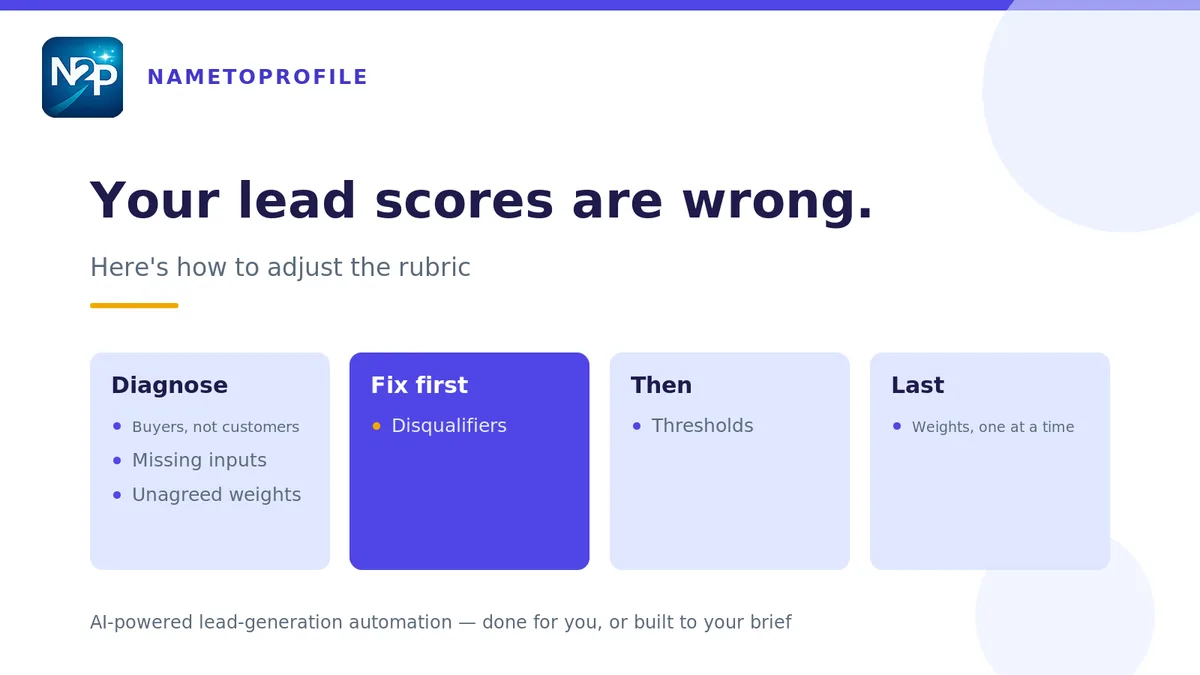
Nearly always one of three things, and they need different fixes.
The rubric is describing your customers instead of your buyers. This is the most common one and the hardest to see, because the rubric usually was built from your best accounts — which is a list of who bought, not who was worth calling. Those are different populations. Plenty of good-fit prospects never bought for reasons that have nothing to do with fit.
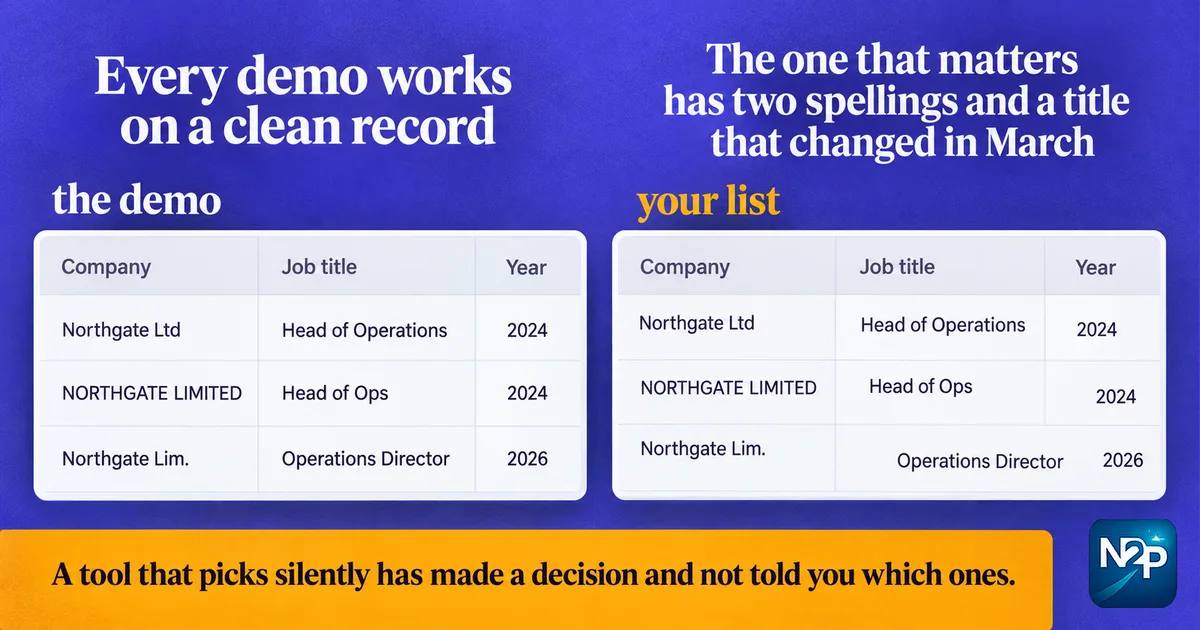
The inputs are missing or stale. A rule that keys off headcount does nothing on records where headcount is blank. If 40% of a list has a gap in the field your top-weighted rule depends on, the model isn't wrong so much as absent — it's scoring on whatever's left.
The weights encode a preference nobody agreed to. Somebody made a judgement call about industry mattering twice as much as seniority, six months ago, in a meeting. It was reasonable then. It's now load-bearing and undocumented.
Work out which one you have before you touch a weight. Changing weights to compensate for missing data is how you end up with a rubric that only works on complete records and quietly misranks everything else.
Should I adjust the rubric or the ICP brief?
The brief, almost always, and more often than people expect.
The scoring rubric isn't a separate artefact — it's part of the ICP brief, alongside your segments, disqualifiers and buying triggers. Change the brief and every tool reading it changes with it: scoring, drafting, enrichment, the done-for-you service. That's the point of defining it once.
Which means a badly-calibrated score is usually a symptom. If "maybe" verdicts keep landing on people who turn out to be junior, the fix isn't a nudge to the seniority weight — it's that your segment definition is too loose about titles. Fix it in the brief, and the rubric follows.
You can have up to three active briefs, so if two segments genuinely need different thresholds, split them rather than averaging them into one rubric that fits neither.
What should I actually change first?
Disqualifiers. Before weights, before thresholds.
Disqualifiers are binary and cheap to verify — wrong geography, wrong company type, a competitor, an existing customer, a segment you don't serve. Getting them right removes noise from the top and bottom of the list at once, and it doesn't require you to have an opinion about relative weighting.
Then thresholds, which is just deciding where "strong" starts. Then weights, last, and one at a time. Changing three weights simultaneously means you learn nothing from the result, which is a lesson most teams get to pay for once.
How do I know if a change actually helped?
Freeze a sample before you change anything. Fifty to a hundred records you've already scored and can judge by hand — ideally with an outcome attached, but a rep's honest verdict works too.
Re-score that same sample after each adjustment and count how many verdicts moved in the direction you expected. If you changed one weight and 60% of the sample reshuffled, the weight was doing far more than you thought.
Watch the middle band especially. A rubric that's confident about the obvious 90s and obvious 10s but shuffles everything between 40 and 60 on a small change isn't calibrated — it's just noisy in the range where the judgement calls actually live.
Fast or Deep — which should I be using while I tune?
Both, in that order, and for different reasons.
Fast scoring is deterministic and rules-based: it returns a 0–100 score and a verdict instantly, cached for 24 hours, and costs 1 credit per score from the live pricing API. Because it's deterministic, it's the honest test of a rubric change — same inputs, same output, and any movement you see came from your edit, not from variance.
Deep scoring is an LLM second opinion at 20 credits. It takes 10–60 seconds and returns a verdict, a written rationale, a recommended action, and a confidence value. The rationale is what makes it useful for tuning: it tells you what a careful reader thought was decisive. When Deep and Fast disagree, that gap is the most informative thing on your screen — it's usually pointing straight at the rule that's miscalibrated.
The practical loop: Fast across the whole sample to see the distribution, Deep on the fifteen or twenty records where you disagree with the Fast verdict, then read the rationales looking for a pattern. There's usually one.
(Current costs are quoted from the live pricing API. The AI Sales Assistant product page currently displays Fast = 2 and Deep = 25 — treat the API values as authoritative.)
Can I re-score just one prospect without re-running the list?
Yes, and it's the fastest feedback you'll get. The AI Sales Assistant scores whoever you're looking at against your brief from a side panel — Fast for an instant read, Deep when you want the reasoning. You can also draft outreach from a strong score, in your voice, with variants you edit before sending. Nothing is sent, posted, or connected on your behalf; every output is text you review and copy.
When you're tuning, keep the panel open and check a handful of real prospects after each change. Fifteen minutes of that will find problems that a spreadsheet of scores will not, because you're seeing the person and the number at the same time.
Does the same rubric work for accounts?
Not without a second pass. Account scoring runs on firmographics — size, industry, geography, technology, buying signals at the company level. Prospect scoring runs on the person. A rubric tuned on people will over-weight role signals that don't exist at the account level, and you'll get a list of companies ranked by something they don't have.
Score accounts on their own criteria, then score people within the accounts that pass. That order is also what makes an account list build useful rather than just large — the point of a target account list is that the ranking survives contact with the reps who have to work it.
How often should I revisit this?
Quarterly is a reasonable default, plus whenever something structural changes — new segment, new pricing tier, a competitor exits, a market you didn't serve becomes one you do.
The one to watch for is drift you can't feel. If reps have started overriding scores routinely, the rubric already stopped matching reality; the overrides are just where it's showing up. Take a look at what they're overriding towards. That's your next rubric edit, already written for you.
Where this fits
If you're building the framework from scratch rather than fixing one, start with how to score B2B leads by fit and then the ICP brief post — the brief is what the rubric lives in, and tuning a rubric without a brief underneath it is just moving numbers around.
And if you're an SDR or outbound rep who inherited a scoring model you had no part in building: the override log is your evidence. Bring it to whoever owns the brief. A rubric adjusted from real disagreement is worth more than one designed carefully in advance, because the disagreement is the only signal you get for free.
100 free credits, no card, no subscription — enough to score a real sample and see where your rubric breaks. Start free.