Ask three vendors what a lead list costs and you'll get three numbers that aren't comparable. One quotes per record. One quotes an annual seat. One quotes "credits." None of them are quoting the number that actually matters, which is what it costs you to end up with a list your reps will work.
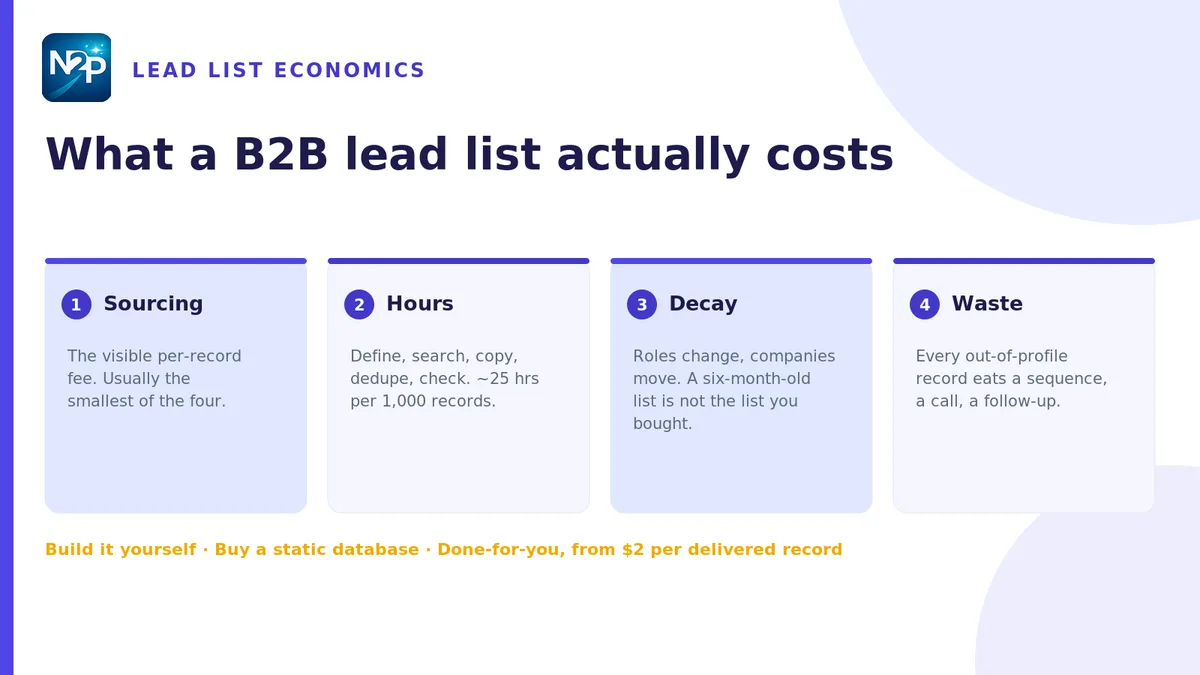
The sticker price is only ever one of four costs. Here's how to price all four, run the arithmetic on the three real routes — build it yourself, buy a static database, or hand over the brief — and pick the one that fits the volume you actually need.
The four costs hiding inside every lead list
1. Sourcing cost
The visible one. A per-record fee, a platform subscription, a credit balance — whatever you hand over to get rows. This is the number everyone compares, and it's usually the smallest of the four.
2. Hours cost
The invisible one, and normally the largest. Someone has to define the criteria, run the searches, copy results into a sheet, deduplicate, fill the gaps, and sanity-check the output before it reaches a rep. Price it honestly: a fully-loaded SDR at $70,000 a year costs roughly $34 an hour. A 1,000-record list assembled by hand at even 90 seconds per record is 25 hours — about $850 of salary buried in a list you already paid for.
3. Decay cost
Data starts aging the moment it's collected. People change roles, companies get acquired, offices move. A list bought once and worked over six months is not the list you paid for — a meaningful slice of it has quietly stopped being true. We've covered how fast B2B data goes stale and which fields decay first; for costing purposes, treat any list older than a quarter as needing a refresh pass you haven't budgeted for.
4. Waste cost
The one nobody puts in the spreadsheet. Every bad-fit record on the list consumes rep attention: a sequence written, a call attempted, a follow-up scheduled, for someone who was never going to buy. If a third of a 1,000-record list is out of profile, you didn't buy 1,000 leads. You bought 670 leads and 330 distractions, and the distractions cost more per unit than the leads did.
Waste cost is the reason "cheap per record" is such a reliable trap. A list at half the price with double the mismatch rate is more expensive, and the difference shows up in your reps' calendars rather than your invoice.
The three routes, priced honestly
| Route | What you pay for | Where the real cost lands | Fits when… |
|---|---|---|---|
| Build it yourself | Tooling and your own time | Hours — heavy up front, then cheap per record once the process is repeatable | Volume is modest and steady, and you want control over every criterion |
| Buy a static database | A per-seat or per-export fee, often annual | Decay and waste — you're buying a snapshot of someone else's coverage, fit unknown | You need breadth fast and can tolerate cleaning the output yourself |
| Done-for-you | A per-delivered-record fee | Sourcing — the hours and the fit-filtering move off your team | Volume is lumpy or large, or the list is blocking a campaign this month |
Building it yourself
The self-serve route is the cheapest per record once you've built the process, and the most expensive while you're building it. The economics turn on repeatability: define the profile once, and every subsequent list reuses it. That's the whole point of writing an ICP brief before you start sourcing — the brief is the asset, the list is just this month's output of it.
Pricing is pay-as-you-go credits with no subscription, so a quiet month costs nothing; the credit costs for each action are published and you start with 100 free credits that never expire. What this route asks from you is attention, not money.
Buying a static database
Fast, broad, and priced as if coverage were the same thing as fit. It isn't. A database sells you rows that match filters; it can't tell you whether the row matches your buyer, because it has never seen your win history. The cost lands after purchase, in the cleaning pass and in the waste rate. If you go this route, budget the cleaning explicitly rather than discovering it.
Handing over the brief
The done-for-you model prices per delivered record, from $2, charged only on delivery — you're not billed for misses, which puts the match-rate risk on the delivery side rather than yours. Deep scoring, email, and phone are priced as add-ons per record, so you buy exactly the depth the campaign needs. That's cash, separate from self-serve credits; the two systems never mix.
In practice this is a built-for-you prospect list when you need people, or an account list built to your target profile when you're running ABM and companies come first. If you're standing up an account-based programme from scratch, the workflow for defining and scoring a target account list is worth reading before you brief anyone — including us.
Run the arithmetic on your own numbers
Take the list you actually need this quarter and fill in five lines:
| Line | How to work it out |
|---|---|
| Records needed | Meetings target ÷ expected conversion rate, then ÷ expected reply rate |
| Sourcing cost | Per-record fee × records, or the subscription amortised across the lists you'll actually build |
| Hours cost | Minutes per record × records ÷ 60 × fully-loaded hourly rate |
| Waste cost | Expected mismatch rate × records × the rep time each bad record consumes |
| Refresh cost | What it costs to re-verify the list if the campaign runs past one quarter |
Two things usually fall out of this. First, the hours line dominates at every volume above a few hundred records — which is why "we'll just do it in-house" stops being cheap much earlier than people expect. Second, the waste line is the one you can shrink without spending anything, by scoring for fit before outreach rather than after.
That second point is the highest-leverage thing on this page. Whichever route you buy, running a fit score across the list — a fast deterministic pass to triage, a deeper pass on the shortlist — moves records out of the waste column before a rep ever touches them. A fast score costs 1 credit and is cached for 24 hours; a deep LLM second opinion costs 20. Against $34-an-hour rep time, triaging a thousand records is not a close call.
For a founder doing this alone
If you're the whole go-to-market function, the arithmetic simplifies: your hours are the scarcest input you have, and they're worth more spent on calls than on copy-paste. Small teams generally get the best return from a hybrid — define the brief yourself so the targeting is genuinely yours, then buy the assembly rather than performing it. You keep the judgment, you sell the labour.
The short version
- Sticker price is the smallest of four costs. Hours, decay, and waste are usually larger and always less visible.
- Cheap per record is often expensive per meeting. Mismatch rate, not row price, decides what a list really costs.
- Build it yourself when volume is steady and you want control; the cost is your attention, and it drops sharply once the brief is written.
- Hand it over when volume is lumpy or urgent; per-delivered-record pricing moves the hours and the match-rate risk off your team.
- Score for fit either way. It's the only line item that shrinks the waste cost instead of relocating it.
You stay in control of the brief and the criteria in every one of these routes — nothing is sent, posted, or connected on your behalf, and every record is reviewable with its score attached. The choice is only ever about who does the assembly.
Start free with 100 credits — no card, no subscription — and price your next list against your own numbers.