Account-based marketing lives or dies on the quality of one artifact: the target account list. Get it right and every downstream play — outbound, ads, events, sales outreach — points at companies that can actually buy. Get it wrong and you spend a quarter personalizing messages for accounts that were never a fit.
The tempting shortcut is to buy a static database dump and call it a list. But a purchased list goes stale the moment it lands, carries accounts that don't match your real ICP, and gives your team no way to tell a strong-fit account from a filler row. A better approach is to build the list from one clear definition, structure it consistently, and score every account for fit before anyone touches it.
Here's a repeatable, platform-broad workflow for doing exactly that. It works across the sources your team already uses — Apollo, ZoomInfo, Clay, your CRM, CSV/Excel exports, and public web sources — rather than locking you into any single platform.
What a good target account list actually contains
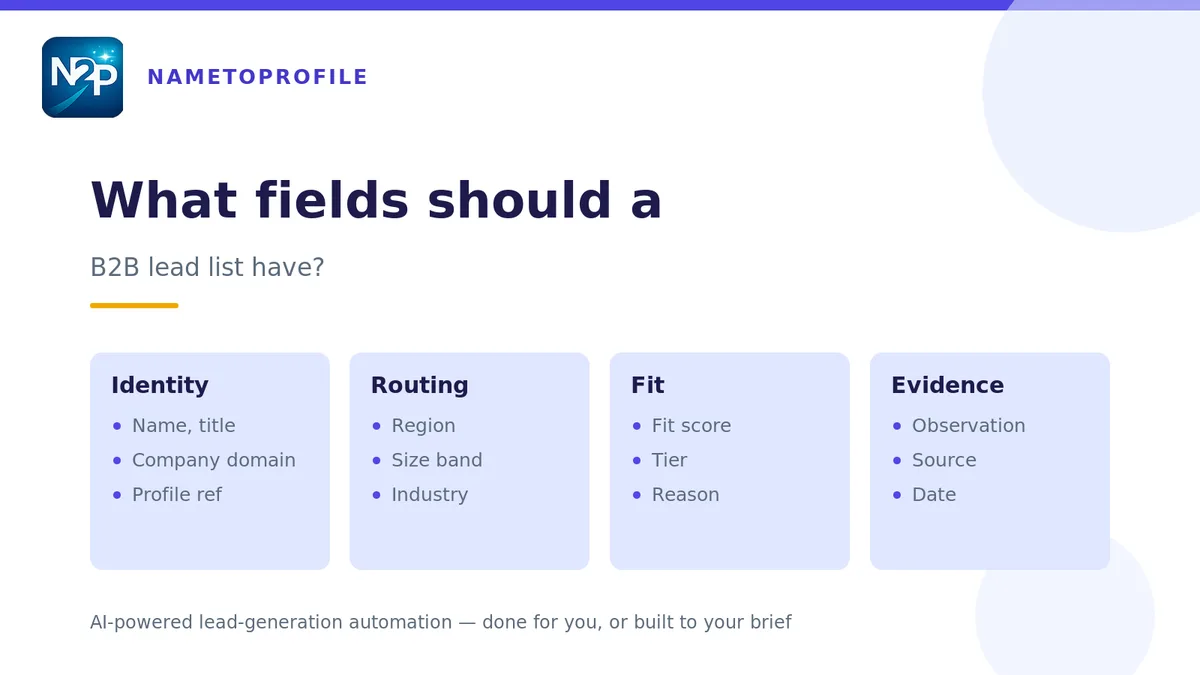
Before the steps, agree on the finish line. A target account list that a sales team will actually use has, at minimum, a consistent set of firmographic fields and a fit signal on every row:
FieldWhy it mattersCompany name + domainThe primary key everything else joins onIndustry / verticalSegments plays and messagingEmployee count / revenue bandSeparates enterprise from SMB motionGeography / HQRouting, territory, and timezoneFit score + verdictLets reps work strong-fit accounts first
If your list has clean versions of these five columns, it's usable. The steps below get you there.
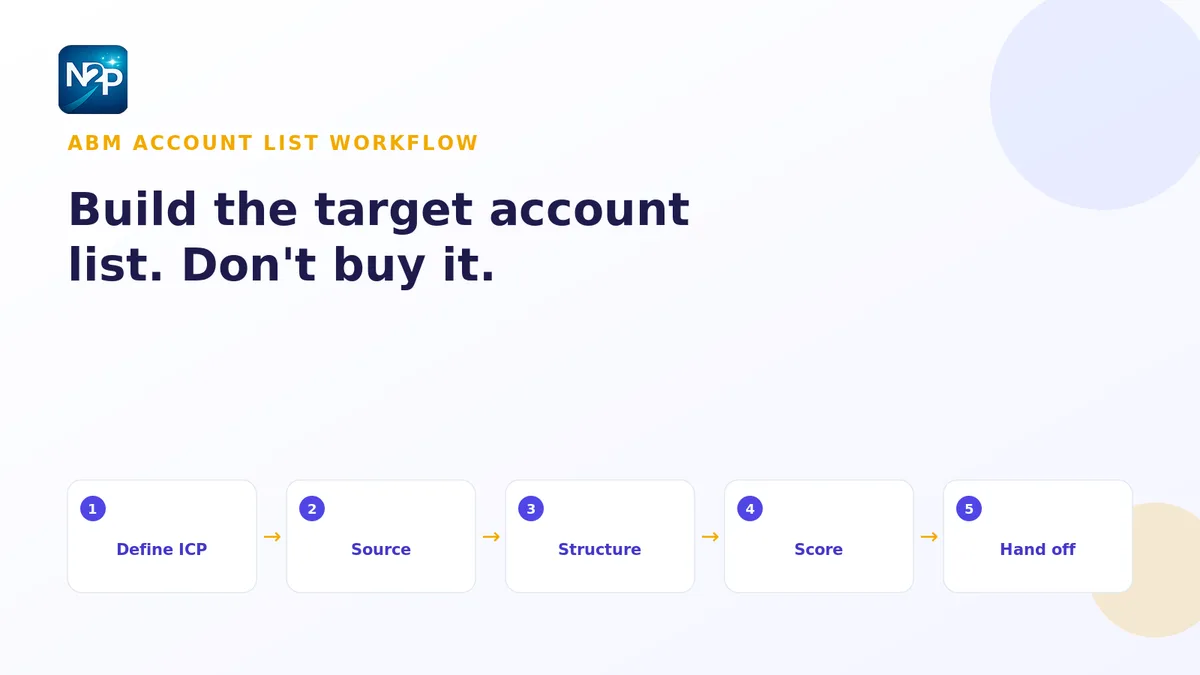
The workflow, step by step
1. Define the account ICP once
Everything starts with a single, written definition of the accounts you want. Instead of holding that in one person's head, capture it as a structured brief: target industries, company-size and revenue bands, geographies, buying triggers, and — just as important — the disqualifiers that rule an account out. When you define your account ICP as one reusable brief, every later step reads from the same source of truth, so sourcing, scoring, and outreach all agree on what "good" means. Define it once; reuse it everywhere.
2. Source candidate accounts from the platforms you already use
With the brief set, pull a wide first pass of candidate accounts from wherever your firmographic data lives — a sales-intelligence platform like Apollo or ZoomInfo, an enrichment tool like Clay, a CRM export, or public web sources. Cast wider than your final target number here; the scoring step will do the narrowing. The goal of this pass is coverage, not precision.
3. Structure the firmographics into consistent fields
Sourced data almost never arrives in the shape your CRM wants. One export calls it "Employees," another "Headcount," a third buries size in a text blob. Normalize everything into the field set above before you go further. To turn messy public company data into consistent, brief-ready firmographics, a company data extractor built to your brief structures the fields your workflow needs from public web sources — so the whole list speaks one schema instead of five.
4. Score every account for fit
This is the step a purchased list skips, and it's the one that makes the list worth working. Run each account against the brief so reps see a fit signal, not just a name. Fast and Deep account scoring gives you both speeds: a fast, deterministic score triages the whole list in one pass and flags obvious disqualifiers, while a deep LLM second opinion adds a written rationale and a recommended action for the shortlist you actually plan to pursue. You stay in control — every score is reviewable, and nothing is sent or acted on for you.
5. Prioritize, then hand off
Sort by verdict, drop the disqualified rows, and hand your team a ranked list where the strongest-fit accounts sit at the top. Because the scores trace back to the same brief, RevOps can keep the definition consistent as the program scales instead of relitigating "what counts as a target account" every quarter. If you're the one keeping CRM data clean and consistent across the go-to-market team, this is the workflow that keeps a RevOps function from drowning in one-off list requests.
Build it yourself, or hand us the brief
The workflow above is the do-it-yourself path, and for many teams it's the right one — you keep full control and pay only for what you use. But if you need volume, or you'd rather your team spend its time on plays instead of list plumbing, you don't have to run every step by hand. Hand over the same account ICP and our done-for-you account list building service delivers a scored, structured, import-ready ABM list — charged only on delivery, never for misses.
It's the same discipline either way: one brief, consistent fields, a fit score on every row. That's the difference between a target account list your team trusts and a database dump they quietly ignore.
Where this fits with the rest of your prospecting
An account list is the top of the funnel, not the whole thing. Once accounts are chosen, the same brief drives contact-level work too — which is why it pays to treat the brief as infrastructure. For the foundations, see how an ICP brief becomes the backbone of better prospecting, and if you run outbound across several clients, the same pattern scales in our guide to cutting manual lead-list building at an agency.
Ready to build your first scored account list? Start free with 100 credits — no card, no subscription.