Most lead lists don't fail because they're too short. They fail because the columns are wrong — twelve fields that look thorough on a spreadsheet, of which four drive a decision and eight are decoration nobody ever filters on.
Rows are the easy part. Deciding which fields a record must carry before it's worth working is the part that determines whether the list gets used or quietly abandoned two weeks after it lands. This is a field-by-field breakdown of what belongs in a B2B lead list, organised into four tiers, with a note on which fields are worth paying for and which you can derive yourself.
The four tiers of a lead record
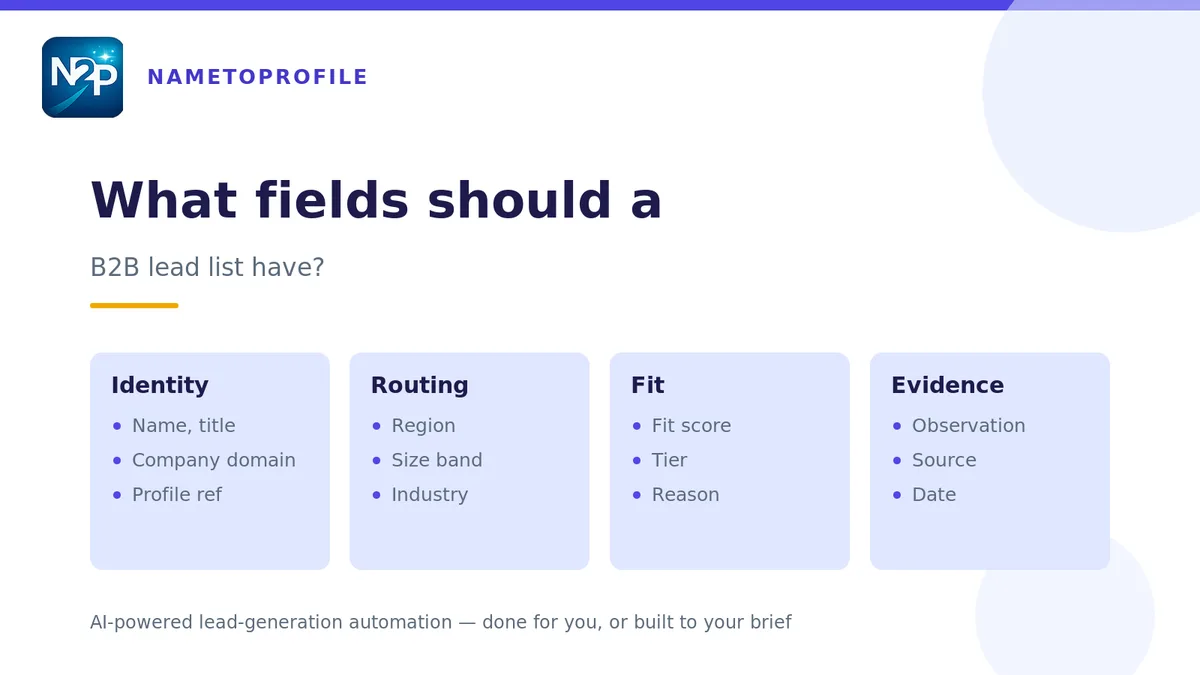
Every field in a usable lead list does one of four jobs. If a field doesn't do one of them, it isn't earning its column.
- Identity — proves this record is a real, specific person at a real, specific company.
- Routing — decides who owns it, which segment it belongs to, and where it goes in your CRM.
- Fit — decides whether it's worth working at all, measured against your ideal customer.
- Evidence — gives the person doing outreach something specific and true to open with.
The tiers are ordered by dependency, not importance. You can't route a record you can't identify, you can't score fit without routing attributes, and evidence is worthless attached to the wrong person.
Tier 1 — Identity fields
Identity is the layer everything else hangs off, and it's where most lists are weakest, because identity is the hardest thing to buy cheaply.
The minimum is: full name, current company name, current job title, a canonical company domain, and a stable public profile reference. Note what's not on that list — an email address. An email is a contact channel, not an identity. Plenty of records carry a plausible-looking email attached to a person who left the company eight months ago.
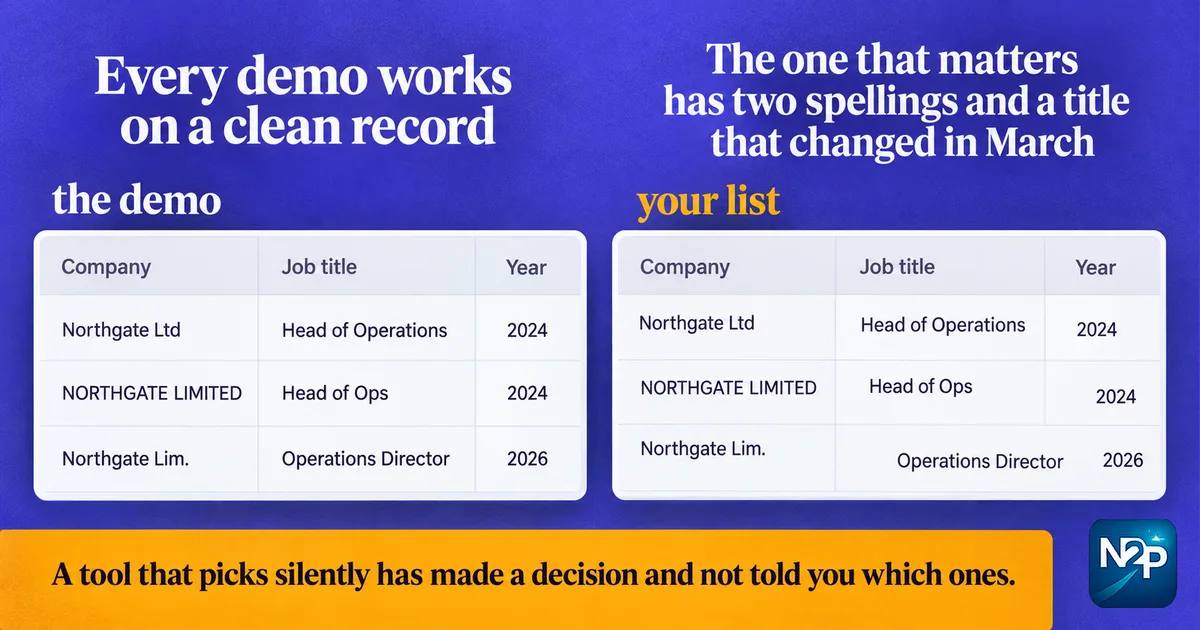
The company domain is the field to insist on. Company names are strings and strings drift; domains are keys. If your list has "Acme Corp", "ACME Corporation" and "Acme Corp." as three rows, you have one account and a deduplication problem. A domain collapses all three.
Identity fields are also the ones you can most reliably build rather than buy. If you already have names and companies, you can turn public profiles into structured, ICP-ready fields built to your own field brief, rather than accepting whatever schema a database vendor happens to ship. The same applies on the account side: structured firmographics pulled from public company sources get you the domain, size and industry attributes without buying a whole database to reach them.
Tier 2 — Routing fields
Routing fields answer "whose is this, and where does it go?" They're unglamorous and they're the reason a list either flows into a CRM cleanly or sits in a spreadsheet forever.
The practical set is: country and region, company size band, industry classification, seniority band, and function or department. Two design notes matter more than the field list itself.
First, band the continuous values. "Headcount: 847" is a number nobody routes on; "Headcount band: 500–1,000" is. Store both if you like, but the band is the field your rules will actually reference.
Second, pick one taxonomy and enforce it. Industry is the classic failure: a list arrives with "SaaS", "Software", "Computer Software" and "Information Technology and Services" as four values describing the same segment. Decide your vocabulary before the list is built, not after.
Tier 3 — Fit fields
This is the tier most lists get wrong, and the reason is subtle: fit fields are not attributes, they're judgements about attributes, and they only mean anything relative to a definition you've written down.
That definition is the point of an ICP brief — one description of who you sell to, which every downstream field is measured against. Without it, "fit score: 78" is a number with no denominator. With it, the same number is a defensible reason to work the record today rather than next month.
A workable fit tier has three fields: a fit score, the tier or band that score falls into, and a short reason string explaining the score. The reason string is the one people skip and the one that earns trust — a score nobody can interrogate gets ignored within a fortnight.
It's also worth being explicit about how the score is produced, because the two common methods behave differently. Fast scoring is deterministic — rules against the brief's attributes, cheap enough to run across an entire list. Deep scoring adds a language-model second opinion and costs meaningfully more per record, which makes it a shortlist tool rather than a whole-list one. Score everything fast, score the top slice deep.
Tier 4 — Evidence fields
Evidence fields exist so the person doing outreach has something specific and true to say. They are the difference between a list that produces replies and a list that produces volume.
Two or three fields is enough: a recent, verifiable observation about the company or the person; the source that observation came from; and the date it was captured. The source and date fields aren't bureaucracy — an unattributed, undated observation is a claim your rep has to take on faith, and the first time one turns out to be a year stale, they stop trusting the whole column.
Contact channels belong here too, and they deserve their own honesty. Email and phone are high-value, high-decay fields, and they should always travel with a confidence indicator and a verification date rather than sitting in the list as bare strings.
The minimum viable schema
Strip everything optional and this is what's left — the columns a record needs before it's worth anyone's time.
FieldTierBuild or buy?DecaysFull nameIdentityEitherRarelyCompany domainIdentityBuild — derivable from public sourcesRarelyCompany name (normalised)IdentityBuild — derive from the domainRarelyJob titleIdentityEitherFast — monthsPublic profile referenceIdentityBuildRarelyCountry / regionRoutingBuildRarelyHeadcount bandRoutingEitherSlow — yearsIndustry (single taxonomy)RoutingEitherSlow — yearsSeniority bandRoutingBuild — derive from titleFast — monthsFit score + reasonFitBuild — requires your briefWhenever the brief changesEvidence + source + dateEvidenceBuildFast — weeksEmail / phone + confidence + verified dateEvidenceBuy or verifyFastest — weeks
Twelve fields. Notice how few of them are genuinely purchasable: most are derived from public information plus your own definition of fit. That's why a schema decided in advance changes what you need to buy — often quite dramatically, and usually downwards.
Fields worth deleting
Three categories are almost always noise. Unbanded precision — exact revenue figures and exact headcounts nobody filters on. Unsourced intent signals — a "high intent" flag with no explanation behind it is a coin flip with a confident label. Duplicated identity — three variants of the company name in three columns guarantees that one day the wrong one gets used in a merge field.
If a field has never once changed what someone did, it isn't a field. It's a column.
Deciding the schema before the list
The order matters more than any individual field choice. Write the schema first, then acquire against it. Doing it the other way round means inheriting a vendor's idea of what matters and spending the next month reconciling it with yours.
A schema written down in advance also gives you something concrete to evaluate suppliers against — feed it into a proper vetting process and you'll find out which fields a source can genuinely populate before you pay, rather than after. On the account side, firmographic fields deserve their own definition pass, because they're the ones most likely to arrive in four incompatible vocabularies. And whatever arrives, expect to normalise it before it reaches the CRM — a clean schema at the front doesn't guarantee clean values at the back.
If you'd rather not run the acquisition yourself, the schema still comes first: a list built to your field definition is a different deliverable from a list bought off a shelf, and the difference is entirely in the brief you hand over.
Where to start
Take your last lead list, open it, and mark each column with its tier. Most people find the same thing: identity is thin, routing is inconsistent, fit is absent, and evidence doesn't exist. Fixing that order — identity, routing, fit, evidence — is usually worth more than another ten thousand rows.
This is the same audience question SDR and outbound teams hit every quarter; if that's your world, the sales prospecting workflow walks through where each tier gets used in practice.
Start free with 100 credits — no card, no subscription — and score your existing list against your own brief to see which fields are actually missing.