"Personalize at scale" usually collapses into a mail-merge with a first name and a company token — which every buyer now reads as automated in half a second. Real personalization isn't a variable; it's evidence that you looked. The good news is that the looking can be systematic. You can run a repeatable process that produces genuinely specific outreach across a large list, without either writing every message from a blank page or blasting the same template to everyone.
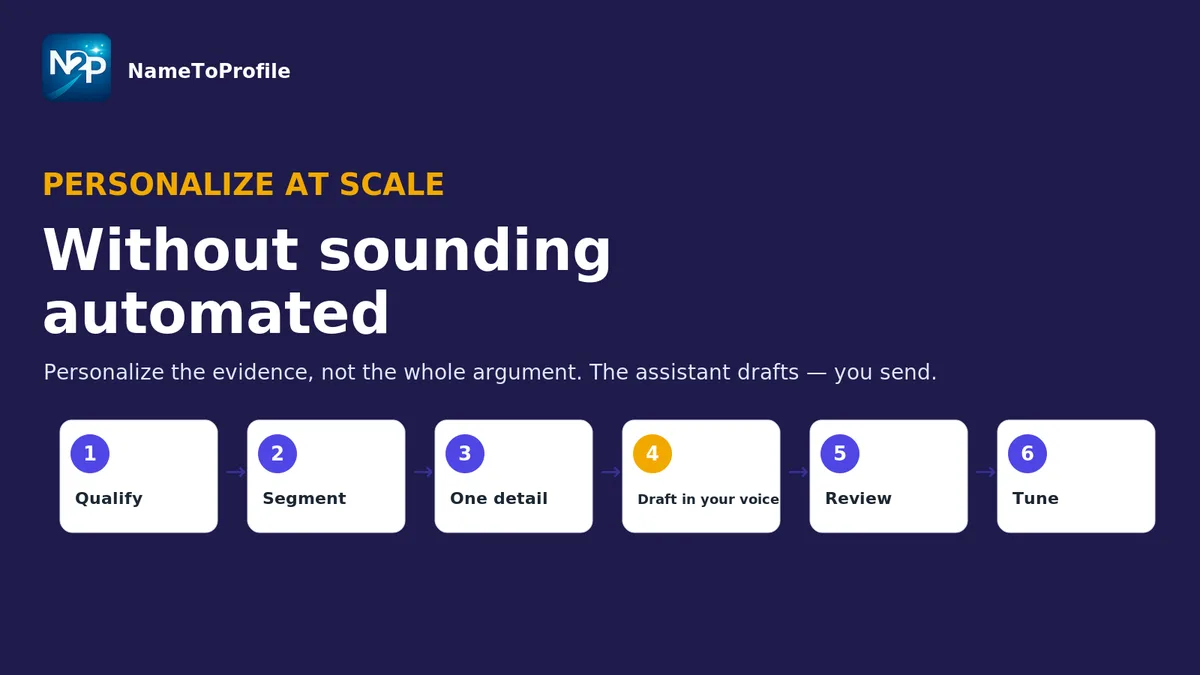
The key is to separate the work into stages: qualify hard so you only personalize people worth the effort, gather one true detail per prospect, then draft in your own voice and review every message before it goes. Here's the process, step by step, using whatever sources you already work in — Apollo, ZoomInfo, Clay, your CRM, CSV/Excel exports, and public web sources.
Step 1 — Qualify before you personalize
Personalization is expensive attention, so spend it only where it can pay off. Before writing anything, score your list for fit and work the strong-fit accounts first. A great message to a bad-fit prospect is still a wasted message. Start from one definition of your ideal customer — an ICP brief — so "good fit" means the same thing on every record, then triage the list with a fast fit-scoring pass and reserve your personalization time for the shortlist. If you want the full framework for this, see how to score B2B leads by fit with a fast-and-deep framework.
Step 2 — Segment by why they'd care, not just who they are
Group your shortlist into a handful of segments defined by a shared reason-to-care — the same trigger, the same pain, the same role facing the same problem. Five tight segments beat five hundred one-off messages, because within a segment your core message is already right and only the proof needs to change per person. This is what makes scale possible: you personalize the evidence, not the entire argument, every time.
Step 3 — Find one true detail per prospect
Specificity is the whole game. For each prospect, find a single concrete, verifiable detail that shows you're writing to them and not a list: a recent role change, something their company actually does, a public post, a launch, a hiring signal. One real detail outperforms three generic compliments. Keep it to one — you're proving you looked, not writing a dossier. Pull these from public sources as part of the same research pass that built the list, so gathering the detail isn't a separate afternoon of tab-juggling.
Step 4 — Draft in your voice, at volume
With the segment message set and one detail per prospect in hand, drafting becomes assembly rather than invention. This is where an assistant earns its place: the AI Sales Assistant reads the prospect against your brief and drafts the outreach in your voice, folding in the specific detail you found — so you get a first draft that already sounds like you and references something real. Crucially, nothing is sent or posted on your behalf; it drafts, you decide. That keeps the volume high and the control with you.
Write to a simple skeleton so every draft stays tight: one line of specific evidence, one line connecting it to a problem you solve, one low-friction ask. If a draft can't name why this person, it isn't ready — send it back for the real detail.
Step 5 — Review every message before it sends
Scale fails when quality control disappears. Read every message before it goes — not to rewrite it, but to catch the draft that's generic, the detail that's wrong, or the tone that's off. A fast review pass is what separates "personalized at scale" from "automated and ignored." Because the assistant drafts rather than sends, this review step is built in: you approve each message, and only then does it leave your hands. This is the same "assistant proposes, you dispose" pattern behind qualifying prospects in the moment — see how to qualify prospects in seconds with an AI sales assistant.
Step 6 — Measure replies, then tighten the loop
Track reply rate by segment, not just overall. When one segment outperforms, your message-to-detail match is right there — copy what's working into the weaker segments. When a segment underperforms, the problem is usually upstream: the fit definition is too loose or the "reason to care" is wrong, not the wording. Feed that back into the brief so the next cycle starts sharper. Personalization at scale is a loop, and the brief is where the learning compounds; if you're still shaping that definition, the ideal customer profile guide with examples and a template is the place to start.
Reps and SDRs running this end to end get the most from treating it as a standing system rather than a one-off campaign — the sales prospecting workflow is designed around exactly this qualify-then-personalize sequence.
The short version
Personalizing outreach at scale isn't about better tokens — it's a process: qualify hard, segment by reason-to-care, find one true detail per prospect, draft in your voice, review every message, and tune by segment. Do that and "at scale" stops meaning "generic." Run it yourself with an assistant that drafts but never sends, and you keep both the volume and the control.
Want to draft your first batch against your own ICP? Start free with 100 credits — no card, no subscription.