An ideal customer profile defines the type of company that is most likely to buy from you, succeed with your product, and become a profitable long-term customer. It gives sales, marketing, RevOps, and customer-facing teams a shared answer to a simple question: which accounts are actually worth pursuing?
Without an ICP, prospecting becomes broad and inconsistent. Reps chase lookalike titles at the wrong companies. Marketing attracts leads that never convert. RevOps builds routing and scoring rules around guesses instead of fit signals.
This guide explains the ICP meaning in sales and business, how an ICP differs from a buyer persona, what to include, and how to use the template to turn your best-fit customer definition into a practical prospecting workflow.
What is an ideal customer profile?
An ideal customer profile, often shortened to ICP, is a structured description of the best-fit account for your business. In B2B sales, the ICP usually describes a company, not an individual person.
A strong ICP includes firmographic, operational, and buying-context signals. That might include industry, company size, geography, growth stage, team structure, technology stack, pain points, buying triggers, disqualifiers, and the roles involved in the decision.
The goal is not to describe every company that could buy from you. The goal is to define the companies where your product is most relevant, your sales motion is most efficient, and your customers are most likely to get value.
ICP meaning in sales
In sales, ICP means the account profile your team should prioritize for prospecting, qualification, scoring, and outreach. It helps reps decide which companies deserve attention before they spend time researching contacts or writing messages.
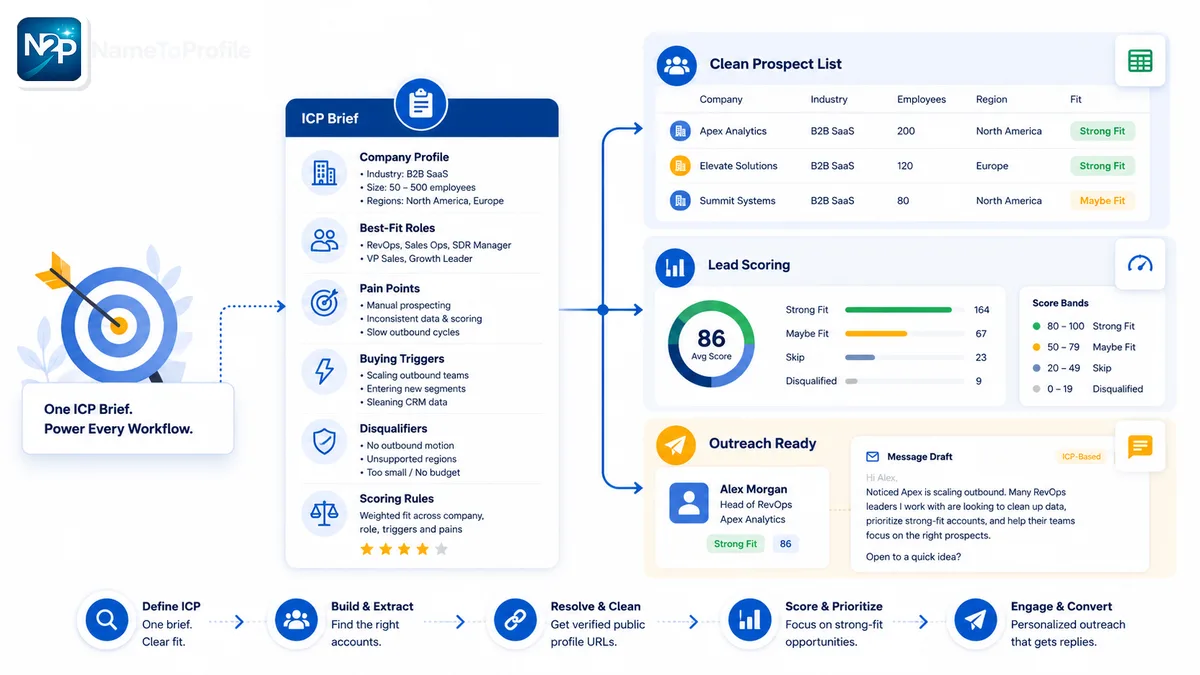
For example, a sales team might define its ICP as B2B SaaS companies with 50 to 500 employees, a dedicated RevOps or Sales Ops function, active outbound motion, and a clear need to clean up prospecting data before outreach.
ICP meaning in business
In a broader business context, an ICP helps align go-to-market strategy. It influences positioning, product packaging, channel strategy, marketing campaigns, sales qualification, customer success planning, and expansion strategy.
A good ICP is not just a sales document. It is a shared operating definition of where the business has the strongest market fit.
ICP ideal customer profile in plain English
Think of your ICP as the account-level filter for your market. It tells your team what a good-fit company looks like before you choose the specific person to contact.
If your buyer persona answers “who should we talk to?”, your ICP answers “which company should we care about in the first place?”
ICP vs buyer persona: what is the difference?
An ICP and a buyer persona are related, but they are not the same. The ICP defines the best-fit company. The buyer persona defines the people inside that company who feel the pain, influence the decision, approve the budget, or use the product.
QuestionICP answersBuyer persona answersExampleWho is the target?The best-fit account or companyThe best-fit person or roleB2B SaaS companies with 50 to 500 employeesWhat does it guide?Account selection, list building, scoring, routing, and segmentationMessaging, objections, pain points, and content anglesPrioritize companies with active outbound teamsWhat data does it use?Industry, size, geography, stage, tools, triggers, disqualifiersTitle, seniority, responsibilities, goals, objectionsTarget RevOps leaders and SDR managers inside the ICPCommon mistakeMaking it so broad that every company qualifiesWriting fictional personas that do not map to real buying roles“Any company that sells B2B” is too broad
For prospecting, start with the ICP. Once the account is a fit, use personas to decide who to contact and how to frame the conversation.
Why an ideal customer profile matters in sales
An ideal customer profile matters because sales teams do not have unlimited time. Every hour spent on a poor-fit account is an hour not spent on a company with a stronger reason to buy.
When the ICP is clear, prospecting becomes easier to repeat. Teams can build better lead lists, score accounts more consistently, personalize outreach around real buying context, and reduce the manual debate around whether a lead is worth pursuing.
Cleaner prospect lists
Most lead list problems start before enrichment or outreach. The list is too broad, the search filters are vague, or the team captures companies that match a keyword but not the market.
An ICP gives list builders a practical filter. Instead of collecting every operations leader or founder, the team can focus on the industries, company sizes, geographies, triggers, and disqualifiers that actually matter.
More consistent qualification
Without an ICP, qualification depends on rep judgment. One rep treats a 20-person startup as promising. Another disqualifies it. One rep values a certain job title. Another ignores it.
A shared ICP creates consistency. It turns account fit into a set of rules that can be discussed, refined, and applied across the team.
Better sales and marketing alignment
Marketing may optimize for lead volume while sales optimizes for qualified conversations. That gap creates friction. An ICP gives both teams the same definition of quality.
For example, marketing can create campaigns for specific ICP segments, while sales can build outreach lists from those same segments. RevOps can then route, score, and report on the same criteria.
Faster rep decisions
A useful ICP speeds up daily decisions. Reps can quickly answer whether an account is strong fit, maybe fit, poor fit, or disqualified.
That matters in outbound sales because small decisions compound. A clearer ICP helps reps decide which leads to research, which accounts to skip, and where to spend extra time on personalization.
What should an ideal customer profile include?
A practical ICP should include both positive fit signals and negative fit signals. Positive signals tell your team what to pursue. Negative signals tell your team what to avoid, even when a company looks attractive on the surface.
Use this checklist as the base for an ICP sales workflow:
- Segment name: A clear label, such as “Mid-market SaaS RevOps teams” or “Founder-led B2B agencies.”
- Industry: The markets where your product has the strongest fit.
- Company size: Employee count, department size, customer count, or another size signal that affects fit.
- Geography: Regions where you can sell, support, and deliver effectively.
- Revenue, funding, or growth stage: Signals that show buying capacity or urgency.
- Team structure: Functions, departments, or roles that usually exist in good-fit accounts.
- Technology stack: Tools the account uses that may create fit, urgency, or integration relevance.
- Pain points: Business problems that make your offer important now.
- Buying triggers: Events that increase urgency, such as hiring, expansion, new funding, new markets, or process changes.
- Disqualifiers: Conditions that make an account poor fit, such as wrong industry, wrong size, low budget, unsupported region, or incompatible workflow.
- Decision-makers and influencers: The roles likely to own the problem, influence the purchase, or approve spend.
- Scoring rules: A simple way to rank strong, maybe, skip, and disqualified accounts.
The scoring rules are where an ICP becomes operational. Instead of keeping the ICP as a paragraph in a document, translate it into criteria your team can use while building lists and qualifying prospects.
Ideal customer profile examples
The best way to understand an ICP is to see how it works in real prospecting. Below are three ideal customer profile examples for common B2B sales motions.
Example 1: SaaS selling to RevOps teams
Best-fit company: B2B SaaS companies with 50 to 500 employees, a defined outbound motion, and a sales team that uses CRM and LinkedIn-based prospecting.
Best-fit roles: Head of RevOps, Sales Ops Manager, VP Sales, SDR Manager, or Revenue Operations Lead.
Buying triggers: Scaling SDR headcount, moving into new segments, cleaning CRM data, launching outbound campaigns, or standardizing lead scoring.
Disqualifiers: No outbound motion, no CRM ownership, very small team with no sales process, or companies selling only through self-serve channels.
Outreach angle: Focus on reducing manual list cleanup, improving routing, and helping reps prioritize accounts that match the sales ICP.
Example 2: Recruiting agency selling to funded startups
Best-fit company: Funded startups hiring for technical, sales, or leadership roles in competitive markets.
Best-fit roles: Founder, Head of Talent, People Lead, or functional leader responsible for hiring.
Buying triggers: Recent funding, new office expansion, multiple open roles, leadership hiring, or missed hiring targets.
Disqualifiers: No active hiring, very low budget, internal recruiting team already covering the role, or hiring needs outside the agency’s specialization.
Outreach angle: Lead with speed, role specialization, candidate quality, and the cost of delayed hiring.
Example 3: Lead-gen agency selling to B2B services firms
Best-fit company: B2B services firms with a defined offer, mid-ticket or high-ticket contracts, and a need for predictable outbound pipeline.
Best-fit roles: Founder, Managing Partner, Head of Growth, or Sales Director.
Buying triggers: New service launch, stalled referrals, new market entry, underused sales team, or recent investment in CRM and outbound tools.
Disqualifiers: Undefined offer, unclear target market, low contract value, no sales follow-up capacity, or companies looking only for one-off lead volume.
Outreach angle: Focus on building a repeatable lead system around a defined ICP rather than sending generic lists.
Ideal customer profile template
Use this ideal customer profile template to define one ICP segment at a time. If you serve multiple markets, create separate segments instead of forcing every customer type into one broad profile.
ICP fieldWhat to defineExampleSegment nameA simple name your team can rememberMid-market SaaS RevOps teamsCompany attributesIndustry, size, geography, stage, business modelB2B SaaS, 50 to 500 employees, North America and EuropeContact attributesRelevant titles, seniority, functions, and buying rolesRevOps, Sales Ops, VP Sales, SDR leadershipCore painThe problem that makes your product relevantManual prospecting workflows and inconsistent lead qualificationBuying triggerEvents or signals that create urgencyScaling outbound, entering a new segment, cleaning CRM dataDisqualifierSignals that should lower priority or remove the accountNo outbound sales motion, unsupported geography, too smallScoring logicHow to separate strong, maybe, skip, and disqualified leadsStrong fit if company size, role, trigger, and pain all matchMessaging angleThe reason the prospect should careBuild cleaner ICP-based lead lists before outreach
For a deeper operating version of this template, read ICP Briefs: The Foundation of Better Prospecting. It explains how to move from a static ICP description to a working brief that supports scoring, prioritization, and outreach.
How to turn your ICP into a sales workflow
An ICP only helps if your team uses it. The next step is to turn the profile into a workflow that supports list building, scoring, outreach, and review.
1. Build lists from ICP criteria
Start with the account filters that matter most: industry, company size, geography, growth stage, relevant departments, and buying triggers. Then add contact-level filters such as title, seniority, and function.
For Sales Navigator workflows, NameToProfile’s Sales Navigator Extractor helps teams turn people and account searches into cleaner lists that can be resolved, scored, and exported for review.
2. Resolve and clean profile URLs
Lead lists often break when they include private or tool-specific profile links that do not work well in CRMs, spreadsheets, enrichment tools, or handoffs. Public profile URLs are easier to review, deduplicate, enrich, and share.
The Sales Navigator Resolver turns Sales Navigator lead links into public LinkedIn profile URLs with a confidence score, so teams can reduce manual profile opening and keep lead records easier to work with.
3. Score leads before outreach
Once the list is clean, score it against the ICP. This is where your profile becomes more than a definition. It becomes a triage system.
NameToProfile Lead Scoring supports Fast and Deep scoring against an approved ICP brief, helping teams separate strong-fit prospects from maybe-fit, skip, or disqualified records before reps spend time on outreach.
4. Draft messaging from the same ICP logic
Messaging improves when it reflects the same fit logic used to build and score the list. A strong ICP can guide which pain to mention, which trigger to reference, and which value proposition to lead with.
NameToProfile Engage drafts LinkedIn messages, comments, and posts from your ICP context and tone. Nothing is posted on your behalf; the output is text your team reviews and copy-pastes.
5. Review and refine
Your ICP should improve as your market feedback improves. Review which accounts replied, converted, stalled, or churned. Then update the ICP segments, scoring thresholds, disqualifiers, and messaging angles.
That feedback loop keeps the ICP connected to real sales outcomes instead of leaving it as a one-time strategy exercise.
Common ICP mistakes to avoid
Most ICP problems are not caused by a lack of information. They happen because the profile is too vague, too broad, or too disconnected from daily sales work.
Making the ICP too broad
“B2B companies” is not an ICP. “Founders” is not an ICP. Broad definitions make teams feel aligned, but they do not help reps decide who to pursue.
A useful ICP forces tradeoffs. It should make some accounts clearly better than others.
Confusing ICP with persona
If your ICP only lists job titles, it is probably a persona document. Titles matter, but they do not tell you whether the account is a fit.
Start with the company profile, then define the people inside that company who matter to the deal.
Ignoring disqualifiers
Disqualifiers are just as important as positive fit signals. They prevent your team from wasting time on accounts that look interesting but rarely convert.
Examples include unsupported regions, companies below your minimum size, industries you do not serve, or accounts without the workflow your product improves.
Treating the ICP as a static document
Your ICP should change as you learn. A segment that looked strong six months ago may produce weak opportunities. A smaller niche may outperform the broader market.
Build a review rhythm so sales, marketing, and RevOps can update the ICP based on pipeline quality and customer outcomes.
Scoring every lead the same way
Different ICP segments may need different scoring logic. A strong-fit founder-led agency may look very different from a strong-fit mid-market SaaS company.
Create separate ICP segments when the fit criteria, pains, triggers, or buying roles differ meaningfully.
Build your ICP once, then use it everywhere
An ideal customer profile is not just a definition. It is the foundation for better sales prospecting, cleaner lead lists, more consistent scoring, and sharper outreach.
The best ICPs are specific enough to guide action. They define who fits, who does not, what signals matter, which triggers create urgency, and how the team should prioritize accounts.
With NameToProfile ICP Briefs, you can define your ideal customer once and use that brief across prospecting, resolving, scoring, and engagement workflows. The workflow stays reviewable and read-only: you bring the inputs, your team stays in control, and nothing is posted on your behalf.
To turn your ideal customer profile into a working prospecting system, start free with NameToProfile.